7 Key Practices Which Separates Sustainability Leaders from Sustainability Laggards

The Sustainability Performance of a firm can be viewed as a spectrum ranging from outstanding to inadequate. Firms rated as Sustainability Leaders are often proactive in addressing sustainability issues, exploring innovative solutions by mobilizing resources and actors interested in particular sustainability issues, and many times setting the sustainability agenda for their industry or geographic region.

Conversely, firms that are considered sustainability laggards often ignore stakeholder concerns about Sustainability and the need to change their behavior. Contrary to leading firms that usually direct their attention externally as much as internally, laggards are marked by a widespread lack of interest in Sustainability and tend to focus on their internal concerns and priorities

Corporate commitment to Sustainability-based Management is strengthening.

Even as organizations overall are strengthening their commitments to Sustainability, one cohort of organization is expanding its commitments far more aggressively than others. They have emerged as Sustainability Strategy Leaders, while others stand as Laggards.

A study conducted between MIT Sloan and BCG Consulting Group, addresses the reasons for the gap which separates Leaders from Laggards of Sustainability.  The study found strategic approach to Sustainability is the main differentiator between Sustainability Leaders and Laggards:

  • Sustainability Leaders — Leaders act on their belief that Sustainability is already at the core of their business and is a necessity to respond well to shifting customer preference.
  • Sustainability Laggards — Laggards view Sustainability in terms of risk management and efficiency gains.

The strategic approach also acts as a differentiator as to how Sustainability Leaders deal with other business parameters, such as:

  • Response to challenges and opportunities in Sustainability.
  • Approach to “terms” of competition in the context of Sustainability concerns.
  • Transformation of management practices in response to Sustainability requirements.

Making early moves even when all needed information around Sustainability is not in place is the first marked step of early adopters of Sustainability.

In a survey of global corporate Leaders conducted by BCG and the MIT Sloan Management Review, it was revealed that an economic downturn caused more emphasis to be placed on Sustainability in companies’ corporate agendas.

As more companies take up Sustainability, the report reveals a striking difference between two groups of companies, based on how they incorporate Sustainability into their business operations.

image (7)

Brief Outline

Sustainability Leaders have high-leverage tactics and strategies that transform the way their organization competes on Sustainability.  They have incorporated  Sustainability into their Strategy Development and Strategic Planning process.  Likewise, they exhibit a broader perspective of Sustainability and its implications to business. They have identified a range of business drivers that support their Sustainability Investments.

  • Increased Margins
  • Increased Market Share
  • Greater potential for innovation in their business models, processes, and access to new markets
  • Competitive Advantage

There are 7 key practices consistently followed by Sustainability Leaders.

  1. Move Early – Leaders take bold steps with an understanding that they need to make early moves even before they have all the answers in place.
  2. Balance Long and Short-Term goals – Sustainability Leaders strike a balance between their overarching vision and being specific about areas where they can gain a Competitive Advantage.
  3. Drive top-down and bottom-up – Leaders recognize that as much as it is a top-down exercise, Sustainability is also a bottom-up exercise.
  4. De-silo Sustainability – Leaders do not drive Sustainability in a silo, instead they integrate it into the very fabric of their business processes.
  5. Measure and monitor – Leaders establish metrics and baselines to measure their progress with Sustainability Initiatives.
  6. Value intangible benefits – Leaders are distinguished by their readiness to ascribe the value of intangible benefits to competitiveness due to Sustainability measures.
  7. Be transparent and authentic – Leaders are realistic with their Sustainability targets, and they openly communicate about their challenges and success around Sustainability.

Interested in gaining more understanding of Sustainability Leaders and their practices?  You can learn more and download an editable PowerPoint about Sustainability-Leaders vs. Laggards here on the Flevy documents marketplace.

Are you a Management Consultant?

You can download this and hundreds of other consulting frameworks and consulting training guides from the FlevyPro library.

Having Problems Maintaining a Stable Talent Pipeline? Apply the 6 Pillars of Talent Management to Master the Art

TM1Enterprises worldwide face problems selecting, staffing, developing, compensating, motivating, and sustaining their key talent.  Building a sustainable Talent pipeline is quite strenuous even for large multinationals.

Replicating best practices from somewhere and applying them alone isn’t sufficient for organizations to build a Talent pipeline and achieve Competitive Advantage.  This warrants overcoming arduous challenges associated with this digital age, including:

  • Adjusting to varying dynamics in global markets
  • Handling the expectations of varied customer segments in different geographies
  • Managing the preferences of key Talent
  • Acquiring new technologies
  • Building novel capabilities
  • Achieving Operational Excellence by streamlining operations and improving processes
  • Exploring new markets
  • Devising strategies to attract, select, develop, assess, and reward top Talent.

Developing Talent Management practices helps the organizations build and retain talented people available in the job market.  The term was first used by McKinsey & Company in 1997, and it pertains to planning and managing strategic Human Capital through activities, i.e. attracting, selecting, developing, evaluating, rewarding, and retaining key people.

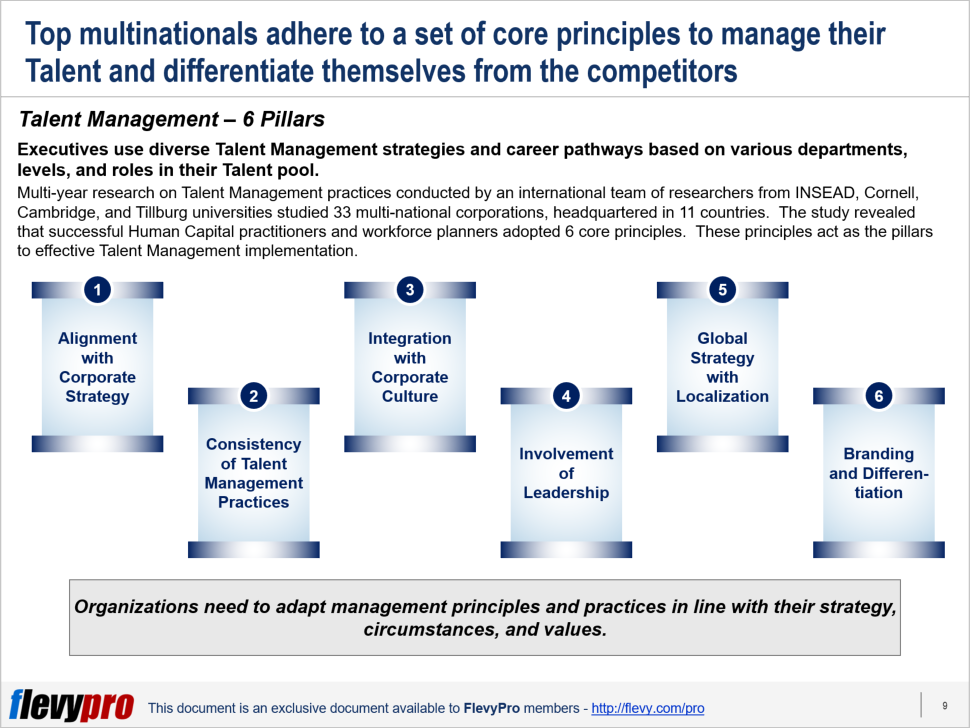
Executives use diverse Talent Management strategies and career pathways based on various departments, levels, and roles in their Talent pool.  Multi-year research on Talent Management practices conducted by an international team of researchers from INSEAD, Cornell, Cambridge, and Tillburg universities studied 33 multi-national corporations, headquartered in 11 countries.  The study revealed that successful Human Capital practitioners and workforce planners adopted 6 core principles.  These principles act as the 6 pillars to effective Talent Management implementation:

  1. Alignment with Corporate Strategy
  2. Consistency of Talent Management Practices
  3. Integration with Corporate Culture
  4. Involvement of Leadership
  5. Global Strategy with Localization
  6. Branding and Differentiation

Let’s discuss the first 3 pillars in detail, for now.

Alignment with Corporate Strategy

Integrating Talent Management with Corporate Strategy is imperative as the need for future Talent depends on the company’s long-term strategy.  Corporate Strategy should guide the identification of Talent required to accomplish organizational goals, since it’s the right Talent that drives the key strategic initiatives rather than strategic planning.

For example, GE’s Talent Management practices have been a great assistance in implementing their strategic initiatives.  The organization regards its Talent Management system as their most potent execution tool and has integrated TM processes into their strategic planning process.  To sustain its image as an innovation leader, GE targets technical skills as a priority in its annual Strategic Planning sessions.  Individual business units lay out their business as well as the Human Capital objectives in GE’s annual strategic planning sessions.  Significant time is spent on reviewing its Innovation pipeline, its engineering function’s structure, and Talent requirements.  To achieve its vision, GE promotes more engineers in its senior management than its rivals.

Consistency of Talent Management Practices

Talent Management practices must be consistent and synchronous with each other.  It is critical not only to invest in advancing the careers of key Talent but also to invest in processes to empower, compensate, and retain them.  Human Capital practitioners utilize various tools to ensure consistency of Talent Management practices, including Human Resources satisfaction surveys and qualitative and quantitative data on TM practices implementation.

For example, the success of Siemens is based on consistent monitoring of its systems, processes, and key performance metrics across its subsidiaries.  Every element of Human Capital Management is connected, continuously assessed, and linked to rewards.  This goes from recruitment of graduates each year, to their orientation, to mentoring and development, to performance evaluation and management, and compensation and benefits.

Integration with Corporate Culture

Corporate culture is regarded as important as vision and mission by renowned global organizations. These companies hold their core values and behavioral standards very high and promote them among their employees through coaching and mentoring.  They strive to embed this into their hiring, leadership development, performance management, remuneration, and reward processes / programs.  So much so that they consider cultural adaptability a crucial element of their recruitment process—as personality traits and mindsets are hard to develop than technical skills—and evaluate applicants’ behaviors and values rigorously.

For example, among other leading companies, IBM has a special emphasis on values while selecting and promoting people.  To ensure consistent values across the board, it organizes regular values jam sessions and employee health index surveys.  These sessions encourage open communication and debate on values and organizational culture and their importance among employees.

Interested in learning more about the other pillars of Talent Management, the various approaches to TM? You can download an editable PowerPoint on 6 Pillars of Talent Management here on the Flevy documents marketplace.

Are you a Management Consultant?

You can download this and hundreds of other consulting frameworks and consulting training guides from the FlevyPro library.

Are You Able to Effectively Navigate the VUCA (Volatile, Uncertain, Complex, Ambiguous) Challenges?

VUCA2VUCA relates to threats that people and enterprises often encounter.  The acronym reflects the constant, dramatically-transforming, and unpredictable world.  The concept originated in 1987, based on the theories of Warren Bennis and Burt Nanus.  The term was first used by U.S. Army War College to describe the volatile, uncertain, complex, and ambiguous general conditions globally.
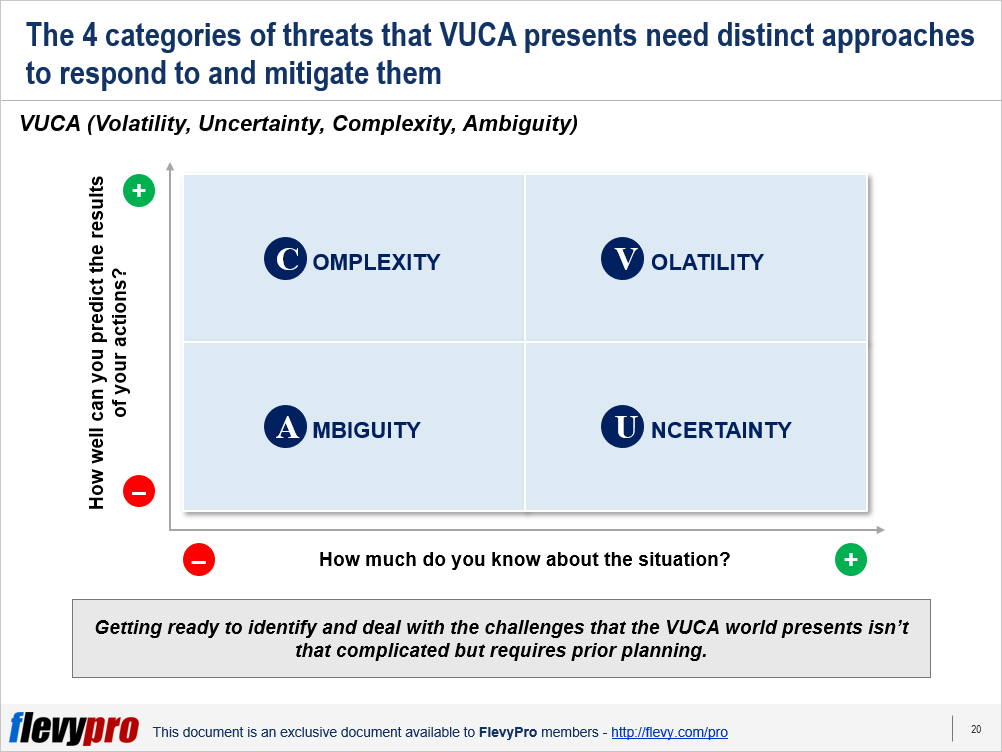

The acronym found traction after 2002, when it was considered an emerging idea to be discussed among the strategic leadership.  The term VUCA stands for:

  1. Volatility
  2. Uncertainty
  3. Complexity
  4. Ambiguity

The 4 VUCA challenges reflect the unpredictable forces of change that affect organizations, necessitating new skills, approaches, and behaviors to mitigate them.  The 4 elements of VUCA relate to how people view the situations where they make decisions, formulate plans, respond to challenges, cultivate change, and solve issues.

VUCA is a practical code for anticipation, understanding, preparedness, and intervention in the wake of uncertainty and confusion.  One of the biggest challenges of managing in a VUCA world involves team members who resist change.  Simply training the leaders on key capabilities isn’t adequate to avoid failures resulting due to not handling the VUCA issues properly.  What differentiates sound Leadership from mediocre management is the leaders’ ability to ascertain key elements that prevent them from adopting resilience and flexibility.

In this age of disruption, Volatility, Uncertainty, Complexity, and Ambiguity are widespread.  These elements will be more prevalent across industries and enterprises in future, and if not managed properly can sap an organization’s and its employees’ strengths.

Let’s discuss these VUCA elements individually.

Volatility

The Volatility element of VUCA talks about the distinct situational categorization of people due to their specific traits or their reactions in particular situations.  People react differently in specific settings due to social cues.  Volatility describes the influence of situations on stereotypes and social categorization, which is the reason why people perceive others differently.

Two factors connect people to their social identities: Normative fit and Comparative Fit.  Normative fit is the degree that a person relates to the stereotypes and norms that others associate with their specific identity.  For example, a Hispanic woman cleaning a house does not get gender stereotypes from others in this situation, but when she eats an enchilada ethnic stereotypes emerge and the gender is forgotten.  Comparative fit relates to specific traits of a person that are prominent in certain states compared to others, which are obvious as others around a person do not have those traits.  For example, a woman in a room full of men stands out, whereas all the men are grouped together.

Uncertainty

The Uncertainty element of VUCA pertains to the unpredictability of information in events, which often occurs in the intention to indicate correlation between events.  Uncertainty is often counteracted by using social categorization (stereotypes), as people tend to engage in social categorization when there isn’t much data about an event.

For instance, when there isn’t enough information to clearly appreciate someone’s gender—as in case of an author’s name when discussing written information—majority of people presume the author is a male.  Social categorization also occurs in case of a race, when people stereotype a certain race to a particular trait.  For example, basketball players are most of the time assumed as black people while golfers are expected to be white.

Complexity

The Complexity element of VUCA relates to the inter-relatedness of several factors in a system.  Complexities due to interactions and dependencies within groups and categories bring unexpected results even in a controlled environment.  There are certain identities in individuals that are more dominant than others.  Other people distinguish these identities, make their assumptions about them, and create stereotypes.  However, complexity in a person’s personality makes it difficult to socially categorize that individual accurately.

Different categories trigger in the mind of the observer, creating positive and negative perception.  It is that positive perception that the observer is more open-minded despite stereotypes and think past the target’s dominant social trait.  Complexities in social identities cause some identities to lessen the noticeability of other identities, making the targets unnoticeable and overlooked.

Interested in learning more about the elements of a VUCA environment, its mitigation, and Robert Johansen’s leadership framework “VUCA Counterweight” or “VUCA PRIME?”  You can download an editable PowerPoint on VUCA (Volatility, Uncertainty, Complexity, and Ambiguity) here on the Flevy documents marketplace.

Are you a Management Consultant?

You can download this and hundreds of other consulting frameworks and consulting training guides from the FlevyPro library.

Are You Able to Differentiate Between General, Corporate, and Competitive Strategy?

Chessboard2Strategy and execution are the 2 critical elements that drive a business.  However, leaders often struggle even with defining—let alone devising and executing—an effective strategy.  Many of those who are responsible to deal with it fall short of describing how they typically employ it.  This failure takes its roots from the fact that there is no clear path associated with strategy.
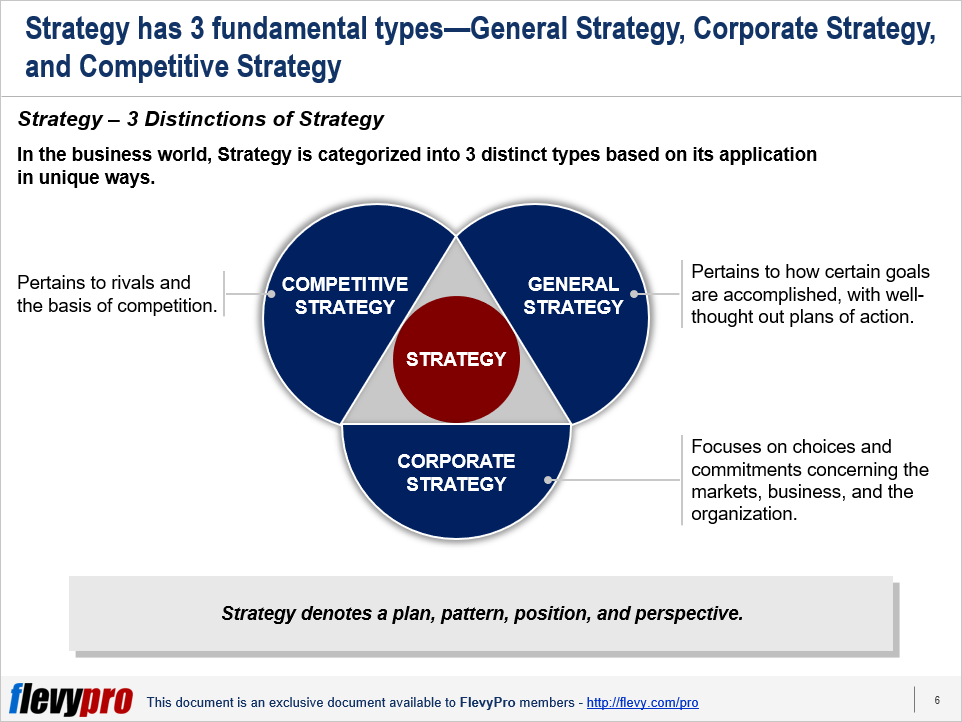
Strategy is about making sound decisions about unforeseen problems.  It’s about selecting the right options—about matters that are often quite ambiguous today but have great significance in the future—based on thorough contemplation, detailed analysis, and creative ideas.  Broadly speaking, strategy encompasses these 3 main elements:

  • A vision and direction
  • A certain position or pattern
  • A deliberated Strategic Plan to achieve strategic goals and vision

Great strategists execute their plans, analyze the results, evaluate their actions, and perform course correction based on the outcomes.  They are not afraid of even revamping their approach entirely.  Senior leaders should clarify their understanding of the concept of strategy and draw attention to the importance of differentiating between the 3 distinct types of strategies before formulating their own course of action:

  1. General Strategy
  2. Corporate Strategy
  3. Competitive Strategy

Let’s delve deeper into the 3 types of strategy.

General Strategy

General Strategy indicates how a specific objective will be achieved, with well-thought-out plans.  The focus of this type of Strategy is on ends (objectives and results) and means (the resources we have to achieve the objectives).  Strategy and tactics combined bridge the gap between ends and means; where Strategy deals with deploying the resources at our disposal while tactics govern their utilization.  A pattern of decisions and actions marks progress from the starting point to achievement of objectives in General Strategy.

Senior executives need to deliberate on the following questions before devising their General Strategy:

  • What do we do?
  • Why are we here?
  • What kind of business are we?
  • What kind of business do we want to become?
  • What is our purpose? What are the results we seek?
  • What is our existing Strategy, is it explicit or tacit?
  • What Strategy and plans may bring about the results we want?
  • What resources we have at our disposal?
  • Are there any constraints in terms of resources that limit our actions?

Corporate Strategy

Corporate Strategy describes what a company does, the purpose of its existence, and what it aims to become.  Corporate Strategy focuses on choices and commitments concerning the markets, business, and the organization.  Corporate Strategy classifies the markets and the businesses in which a company will operate.  This type of strategy is typically decided in the context of defining the company’s mission and vision.

A detailed assessment of the existing strategy, market, competition and environment is critical for devising the Corporate Strategy.  Strategists indicate that there are critical elements that should be factored in while formulating Corporate Strategy.  These elements include product or service offerings, resources, marketing and sales approaches, manufacturing capabilities / capacity, customers, distribution channels, technology, type of market and its requirements, and revenue and profit goals.

While formulating Corporate Strategy, senior executives should consider and seek answers to the following questions:

  • What is our existing Corporate Strategy?
  • Is our Corporate Strategy explicit or tacit?
  • What are the critical assumptions that make our existing strategy viable?
  • What is going on in the market—in terms of social, political, technical and financial environment?
  • What do we seek to accomplish in terms of our growth, size, and profitability targets?
  • What markets we are eyeing to compete in?
  • What businesses we intend to operate in?
  • What locations and geographies will we compete in?

Competitive Strategy

Competitive or Business Strategy specifies for an enterprise the core reason on which it contests its rivals.  It depends on an organization’s competences, advantages, and disadvantages compared to the market and the rivals.

Interested in learning more about the General, Corporate, and Competitive Strategies? You can download an editable PowerPoint on The 3 Distinctions of Strategy here on the Flevy documents marketplace.

Are you a Management Consultant?

You can download this and hundreds of other consulting frameworks and consulting training guides from the FlevyPro library.

How to Employ Internet of Things (IoT) System to Fast-track Decision-Making in the Manufacturing Sector?

Manufacturing1Manufacturing today entails immediate yet informed decision making.  However, with increasing levels of sophistication and production, senior leadership often has limited time to make optimum decisions pertaining to the number of unanticipated issues surfacing from time to time.  These issues—if not managed properly and timely—can lead to defects and wastes.

Top global enterprises are utilizing innovation and creative ways to enable prompt decision making.  Specifically, they are using Internet of Things (IoT) to effectively handle critical aspects of manufacturing.  Successful implementation of a Manufacturing IoT system facilitates in automating key tasks, decisions and processes; curtailing scrap and rework; and enhancing productivity.

People often object to implementing an IoT system by citing other important projects that they are already undertaking and the resource and time constraints as pressing hurdles.  To work around these limitations, manufacturers can engage 3rd party consultants having proven expertise in end-to-end successful IoT, Asset Tracking, and manufacturing systems deployment.

Implementing a Manufacturing IoT System leverages immense benefits, including:

  • Enhancing the ROI of other programs under way.
  • Streamlined and Process Improvement and Robotic Process Automation help prompt informed decisions.
  • Managing materials efficiently.
  • Adjusting to customer requirements.
  • Avoiding costly mistakes and rework.

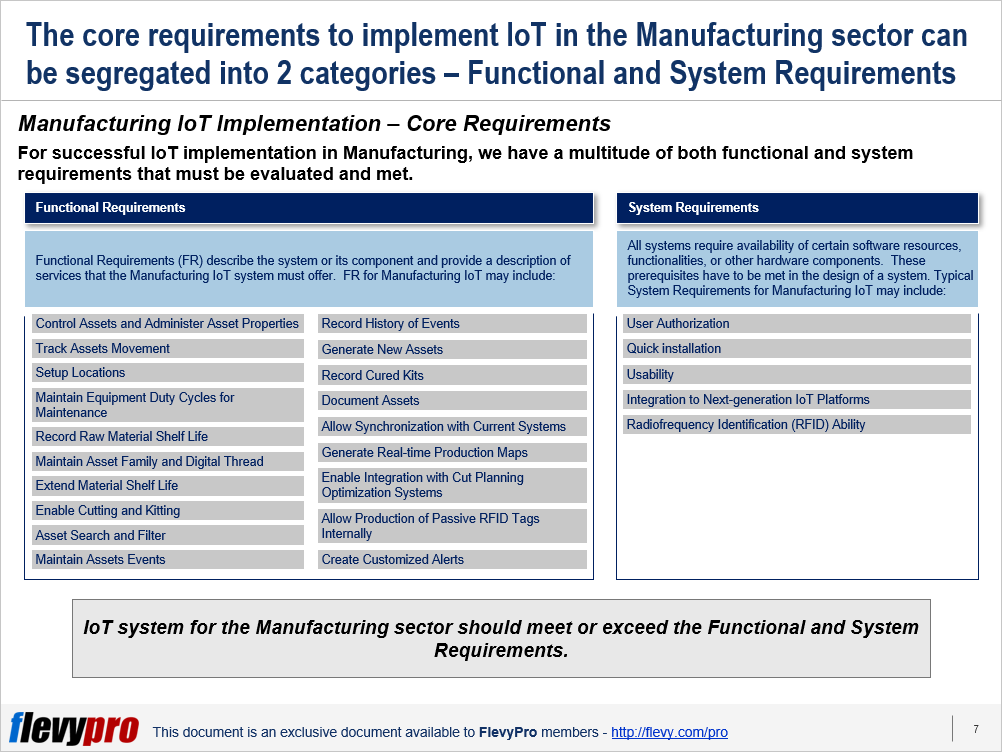
However, harnessing IoT necessitates careful deliberation and planning.  The core requirements to effectively implement a Manufacturing IoT system can be segregated into 2 broad categories:

  1. Functional Requirements
  2. System Requirements

Functional Requirements

Functional Requirements (FR) describe the system or its components.  FR provide a description of services that the Manufacturing IoT system must offer.  FR for Manufacturing IoT may include:

  • Control Assets and Administer Asset Properties
  • Track Assets Movement
  • Setup Locations
  • Maintain Equipment Duty Cycles for Maintenance
  • Record Raw Material Shelf Life
  • Maintain Asset Family and Digital Thread
  • Extend Material Shelf Life
  • Enable Cutting and Kitting
  • Asset Search and Filter
  • Maintain Assets Events
  • Record History of Events
  • Generate New Assets
  • Record Cured Kits
  • Document Assets
  • Allow Synchronization with Current Systems
  • Generate Real-time Production Maps
  • Enable Integration with Cut Planning Optimization Systems
  • Allow Production of Passive RFID Tags Internally
  • Create Customized Alerts

System Requirements

All systems require availability of certain software resources, functionalities, or other hardware components.  These prerequisites have to be met in the design of a system.  Typical System Requirements for manufacturing IoT may include:

  • User Authorization
  • Quick installation
  • Usability
  • Integration to Next-generation IoT Platforms
  • Radio-frequency Identification (RFID) Ability

Let’s delve deeper into some of the Functional Requirements for now.

Control Assets and Administer Asset Properties

The system should be able to manage multiple assets and add new assets.  It should be capable of:

  • Creating asset properties, e.g., name, ID and shipment date.
  • Editing property labels and show / hide asset properties.
  • Automatically adding materials’ expiry date, “remaining exposure time,” “tool autoclave cycles left,” and “tool usage time left.”

Trace Assets Movement

The IoT system should be able to:

  • Follow assets location from one site to another during the manufacturing process.
  • Allow integration of MAT with RFID and other floor sensors to gather real-time assets’ location and condition data.
  • Enable asset location reporting manually, through barcode, or hybrid (barcode and RFID).

Setup Locations

The system should maintain:

  • Asset data from multiple sites (locations).
  • Assets movement to and fro various sites, reported using RFID or other sensors.

Maintain Equipment Duty Cycles for Maintenance

The IoT manufacturing system should record all maintenance needs and maintenance activity performed on an asset.  Specifically it should:

  • Keep data on all tools available at various sites with their duty cycles for preventive maintenance.
  • Maintain record and generate reports on maintenance activity preformed on a specific tool.

Record Raw Material Shelf Life

The IoT manufacturing system should:

  • Automatically calculate raw material and work in process exposure time and date of expiration.
  • Maintain assets’ shelf life and generate automated screen notifications, alerts, emails, or SMS.

Interested in learning more about the details of other Functional and System Requirements of a Manufacturing IoT system? You can download an editable PowerPoint on Manufacturing: Internet of Things Implementation here on the Flevy documents marketplace.

Are you a Management Consultant?

You can download this and hundreds of other consulting frameworks and consulting training guides from the FlevyPro library.

Shareholder Value Traps: How to Evade Them and Focus on Value Creation for Your Organization

Value Trap1Changing industry ecosystems and competition today demand from the organizations to undergo strategic shifts.  The purpose of a company is undergoing Business Transformation from serving the interest of shareholders to serving all stakeholders that influence the organization.
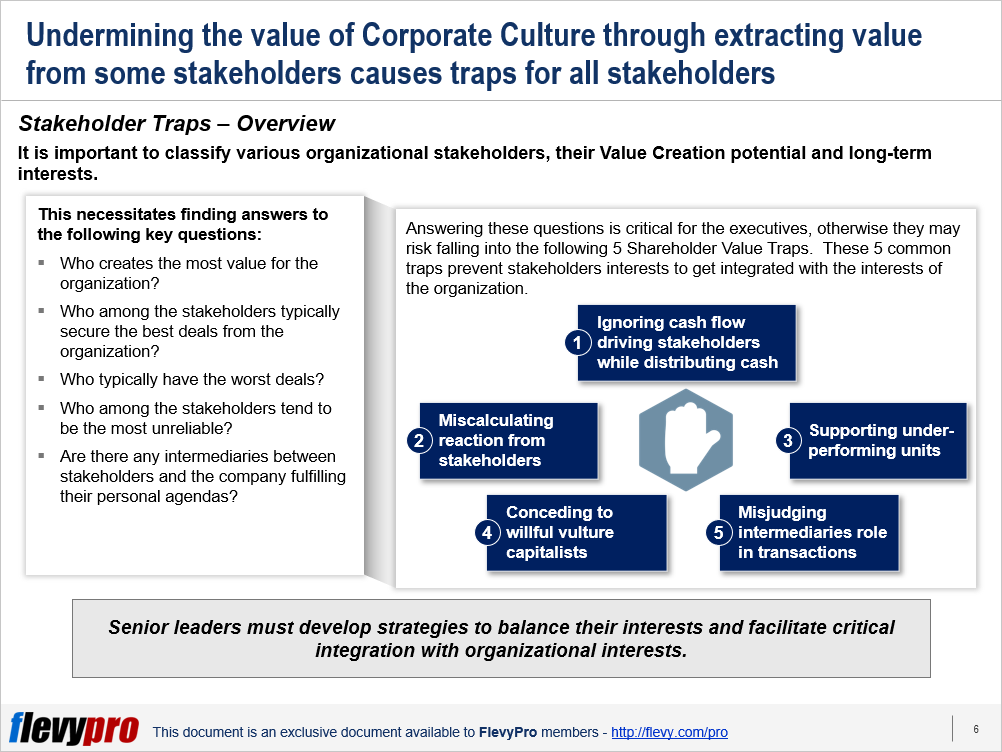
Shareholders are often considered the only stakeholders that invest in a business.  Senior management needs to be cognizant of the importance of shareholders as well other stakeholders who create value for the organization.  They should work on building a collaborative Organizational Culture and paying heed to the welfare of all those groups that play a role in organizational growth.

This warrants a thorough evaluation of all stakeholders, their long-term interests, and Value Creation—or Value Destruction—potential for the organization.  But first, this calls for finding answers to the following key questions:

  • Who creates the most value for the organization?
  • Who among the stakeholders typically secure the best deals from the organization?
  • Who is the victim of having the worst deals from the organization?
  • Who among the stakeholders is potentially untrustworthy?
  • Are there any intermediaries or stakeholders fulfilling their personal agendas?

Answering these questions is critical for the executives, otherwise they may risk falling into Shareholder Value Traps.  Recognizing and understanding stakeholder value traps while the managing stakeholders‘ various interests helps executives achieve shared and individual long-term goals.  These 5 common traps prevent stakeholders’ interests to get integrated with the interests of the organization and destroy the value of a company if overlooked:

  1. Ignoring cash-flow driving stakeholders while distributing cash
  2. Miscalculating reaction from stakeholders
  3. Supporting under-performing units
  4. Conceding to willful vulture capitalists
  5. Misjudging intermediaries role in transactions

Let’s discuss 3 of these stakeholder traps individually.

TRAP 1 – Ignoring cash-flow driving stakeholders while distributing cash

Shareholders are often treated as the critical drivers of long-term cash flows.  However, they are often short-term cash flow generators, whereas other stakeholders who provide their input for the organization in the form of their competencies and experience deliver long-term value.  These real contributors should be given top priority when distributing cash on earnings.  Underestimating or failure to identify the real long-term cash-flow generators can be a fatal value trap for an organization.

TRAP 2 – Miscalculating reaction from stakeholders

Another trap that most executives fall victim to is discounting potential backlash from weak stakeholders upon unfair distribution of cash / incentives.  Mining value from these victims to support shareholder disbursements can be equally detrimental, as annoyed stakeholders—with the help of social media and NGOs—, legal battles, and financial penalties can devastate a firm’s reputation and financial health.

TRAP 3 – Supporting under-performing units

Senior executives and boards at some organizations foster free riders—stakeholders that sap more benefits from the enterprise than the business they generate—at the expense of long-term value shareholders.  Free riders include an under-performing department close to the board, or a dwindling business unit that is part of a profitable section and whose financials are not categorized separately.

Continued support to these free riders is often at the cost of allocating resources to other potentially more profitable ventures, and this practice has led many companies to losses and even bankruptcies.

Interested in learning more about the Stakeholder Value Traps, types of organizational stakeholders, and strategies to stay clear of the Stakeholder Value Traps?  You can download an editable PowerPoint on Shareholder Value Traps here on the Flevy documents marketplace.

Are you a Management Consultant?

You can download this and hundreds of other consulting frameworks and consulting training guides from the FlevyPro library.

Digital Facilitation – Embrace the Future Work Environment

Stock Image 2 - Digital Facilitation PrimerIn the wake of global pandemics when meeting face to face is not possible, it’s about facilitating workshops digitally, designing a formal agenda, and utilizing digital tools to ensure a productive virtual meeting.  Digital Collaboration Platforms have been pivotal in the current scenario.
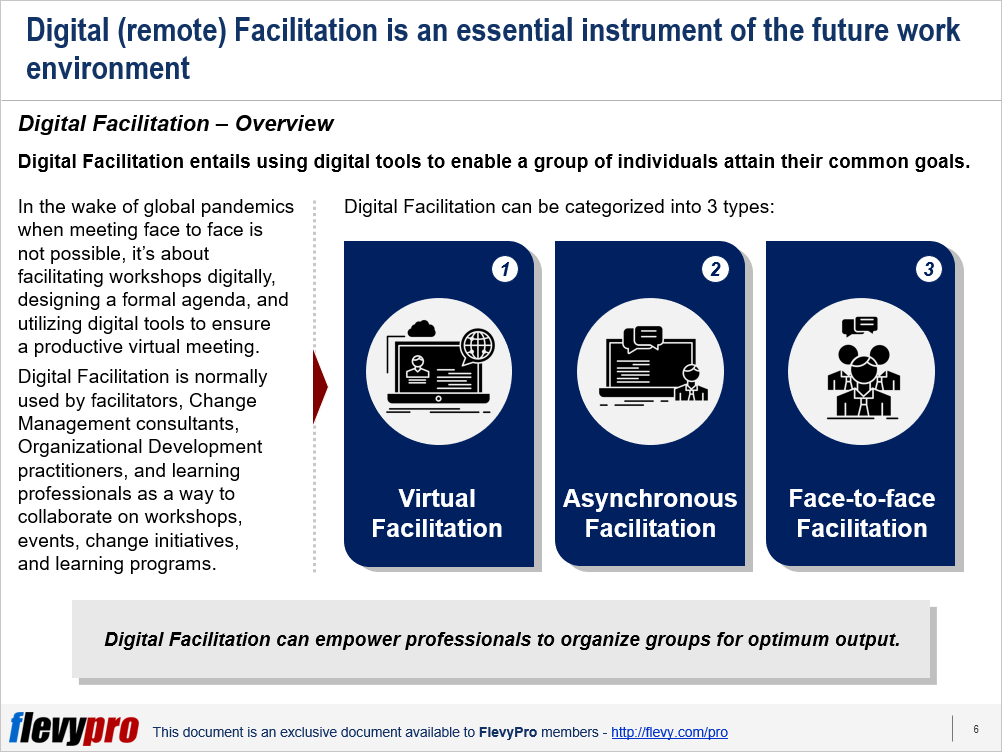
As a matter of fact, Digital Collaboration platforms have become a new norm and have forever transformed business work environment.  Digital Facilitation tools are extensively used by facilitators, Change Management consultants, Organizational Development practitioners, and learning professionals as a way to collaborate on workshops, events, change initiatives, and learning programs.

Digital Workshop Facilitation can be categorized into the following 3 major types:

  1. Virtual Facilitation

In this type of Digital Facilitation, a group collaborates remotely in real time but from different locations.  Common tools used are Zoom, GoToMeeting etc.

  1. Asynchronous Facilitation

In this facilitation method, a facilitator leads participants remotely at a different time and place. Common tools include Email, Slack etc.

  1. Face-to-Face Facilitation

In Face-to-Face facilitation, a facilitator interacts with a group of people in the same workshop space, in person.  Digital tools can be used in such a setup instead of flip charts and sticky notes.

The new scenario brings forth new challenges in workshop facilitation that necessitate robust principles, methods, and tools for the future work environment to run smoothly.  Understanding and adhering to the following best practices and principles in Digital Workshop Facilitation helps in attaining effective results just like face-to-face workshops:

  1. Specify well-defined guidelines and expectations.
  2. Form an assured environment to enable discourse.
  3. Ensure effective interaction before, during, and after a workshop.
  4. Ensure all voices are heard.
  5. Document the conversations.
  6. Alter the moderation approach based on the participants’ level of understanding.
  7. Seek comments and iterate.

Let us delve a little deeper into some of the principles:

1. Specify well-defined guidelines and expectations.

The remote nature of digital workshops limits the element of reacting to audience’s lack of attention.  This warrants clear instructions regarding ground rules, both in writing and orally to compensate for this disadvantage.  Participants need to use precise language in asking questions and answering them.

Instructions on technology and tools usage should be reiterated from time to time.

2. Form an assured environment to enable discourse.

Trusting participants in a virtual setting is difficult if you do not know them.  It is the digital facilitator’s job to create conversation security in different ways.  Spending time on icebreakers or other pre-engagement activities may ease the discomfort.  Providing quick and positive feedback to those who actively contribute encourages shy participants and creates a positive environment.  Informing the participants on how meetings are being documented and information on who has access to this documentation can reassure participants.

3. Ensure effective interaction before, during, and after a workshop.

Digital Facilitation platform can be used ahead of a meeting to help participants familiarize with each other, disseminate the agenda, initiate discussions, or obtain helpful information from the participants, such as questions, skill levels, ideas, etc.  Digital Collaboration Platform should be the center of post-workshop activities, e.g., sharing documents, closing agendas, answering additional queries, and extended discussions.

4. Ensure all voices are heard.

Digital Workshop tools can facilitate participation of people who in a traditional workshop setup will not be able to participate due to dominance by a few individuals.

Interested in learning more about the Digital Workshop Facilitation principles, methods, and tools? You can download an editable PowerPoint on Virtual Work Digital Facilitation (Primer) here on the Flevy documents marketplace.

Are you a Management Consultant?

You can download this and hundreds of other consulting frameworks and consulting training guides from the FlevyPro library.

Learning Organizations: Making Supplier Networks A Competitive Advantage For You

LO Stock image 2Large manufacturers are often reluctant to share knowledge with suppliers.  However, supplier networks are considered a great source of gaining competitive edge by Learning Organizations.
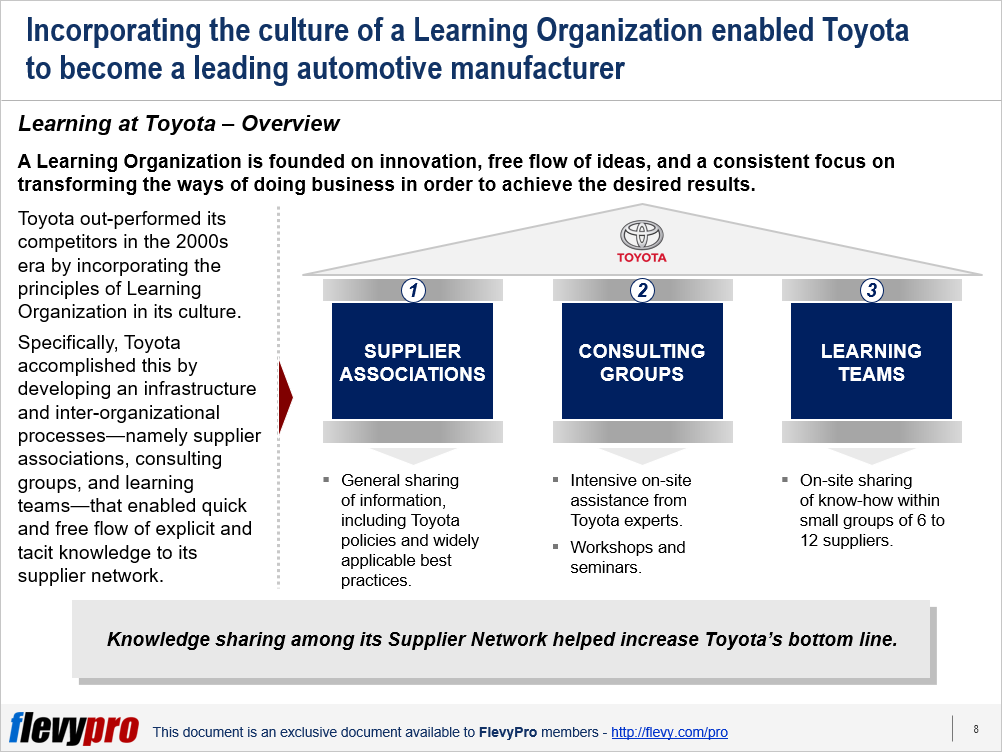
A Learning Organization is founded on innovation, free flow of ideas, and a consistent focus on transforming the ways of doing business in order to achieve the desired results.  For instance, Toyota out-performed its competitors in the 2000s era by incorporating the principles of Learning Organization in its culture and sharing technology and knowledge with its suppliers.  This resulted in less defects, lower inventory levels, and improved labor productivity for its suppliers and higher profits for Toyota.

Specifically, Toyota became a Learning Organization by developing the infrastructure and inter-organizational processes that enabled quick and free flow of explicit and tacit knowledge to its supplier network.  The Learning Organization at Toyota features 3 inter-organizational processes, which became foundational to its approach to Supply Chain Management:

  • Supplier Associations
  • Consulting Groups
  • Learning Teams

Let’s dive deeper into these processes.

Supplier Associations

Supplier Associations were setup by Toyota, initially, to share information, valuable experience, and to extract feedback.  The knowledge-sharing mechanisms that Toyota’s Supplier Associations employ include high-level sharing of explicit knowledge within the supply network regarding production plans, policies, and market trends.  The Supplier Associations hold bimonthly/monthly meetings to discuss key topics that include cost, quality, safety, best practices, and social activities.

These Supplier Associations enable suppliers to build relationships in Toyota at higher levels which was not a common practice in the industry.  This resulted in tremendous improvements in supplier performance due to explicit information and experience-sharing, which ultimately benefited Toyota to achieve excellence.

Consulting Groups

By establishing Consulting Groups in the 1960s, Toyota started the practice of providing free consultation regarding valuable production knowledge to its suppliers through experts.  This was accomplished through the creation of Operations Management Consulting Department (OMCD) in Japan in the 1960s and Toyota Supplier Support Center (TSSC) in the U.S. in 1992.

By developing the Consulting Groups infrastructure, Toyota’ consultants spent significant time at their supplier sites free of charge, helping them resolve problems in the Toyota Production System (TPS) implementation.  Suppliers, in turn, were encouraged to share their project results and open their operations to one another.  This explicit sharing of results and knowledge enabled other suppliers to replicate best practices and benefited Toyota by negotiating Target Pricing with its suppliers.

Learning Teams

Learning Teams—the 3rd pillar of a Learning Organization—were pioneered by Toyota in 1977 by organizing its suppliers into Voluntary Study Groups in Japan or Plant Development Activity (PDA) groups in the U.S.  The Learning Team collaborated voluntarily on production and quality management.

 The Learning Teams were—and still are—responsible for determining a theme and spending time addressing each member’s problems related to that theme, making the members learn significantly by having outside pair of eyes look at their problems.  This helped Toyota’s suppliers’ network achieve effective tacit knowledge transfer, explore new ideas and applications of Toyota Production System (TPS), transfer valuable lessons learnt to all stakeholders, and enhance production quality.

Toyota follows a deliberate step-wise path to create Knowledge-Sharing Networks.  These Knowledge-Sharing Networks are an invaluable resource for enhancing both overt and implicit information and experiences for the organization.

Key dynamics of Toyota’s Knowledge-Sharing Networks involve creating a non-threatening one-on-one relationship with suppliers through the Suppliers Association in the form of financial as well as valuable knowledge-sharing assistance.

Interested in learning more about the dynamics of Toyota’s Knowledge-Sharing Networks, the fundamental barriers to learning, and their implications on the suppliers and the manufacturer?  You can download an editable PowerPoint on Learning Organization:  Supplier Networks here on the Flevy documents marketplace.

Are you a Management Consultant?

You can download this and hundreds of other consulting frameworks and consulting training guides from the FlevyPro library.

When Survival in the Midst of Chaos Calls for Supply Chain Sustainability

In the modern age, organizations are striving to form a sustainable Supply Chain system to cope with the challenges that are arising. Such issues include the pic 1 Supply Chain Sustainabilityemission of hazardous substances, excessive resource consumption, Supply Chain risks, and complex procedures.

Through Strategic Planning, organizations around the globe are adopting strategies to become a sustainable organization.  In fact, there is an increasing trend towards organizations adopting sustainable Supply Chain Management practices.

Gaining a Foothold on Supply Chain Management

Supply Chain Management is the design, planning, execution, control, and monitoring of Supply Chain activities. It addresses the fundamental business problem of supplying products to meet demand in a complex and uncertain world.

Looking at Supply Chain Management, we can see that it draws on the value chain concept of business strategist, Michael Porter.  It looks at supply issues at the multi-company level.  It creates net value, builds a competitive infrastructure, leverages worldwide logistics, synchronizes supply with demand, and measures performance globally.

The need for Supply Chain Management came about when shorter product life cycles and greater product variety has increased Supply Chain costs and complexity.  And as outsourcing, globalization, and business fragmentation became a common practice, there was now the need for Supply Chain integration. This was further emphasized with the advances in emergent technologies. which created more opportunities for Digital Transformation within Supply Chains.

The 4 Levels of Supply Chain Management Strategies

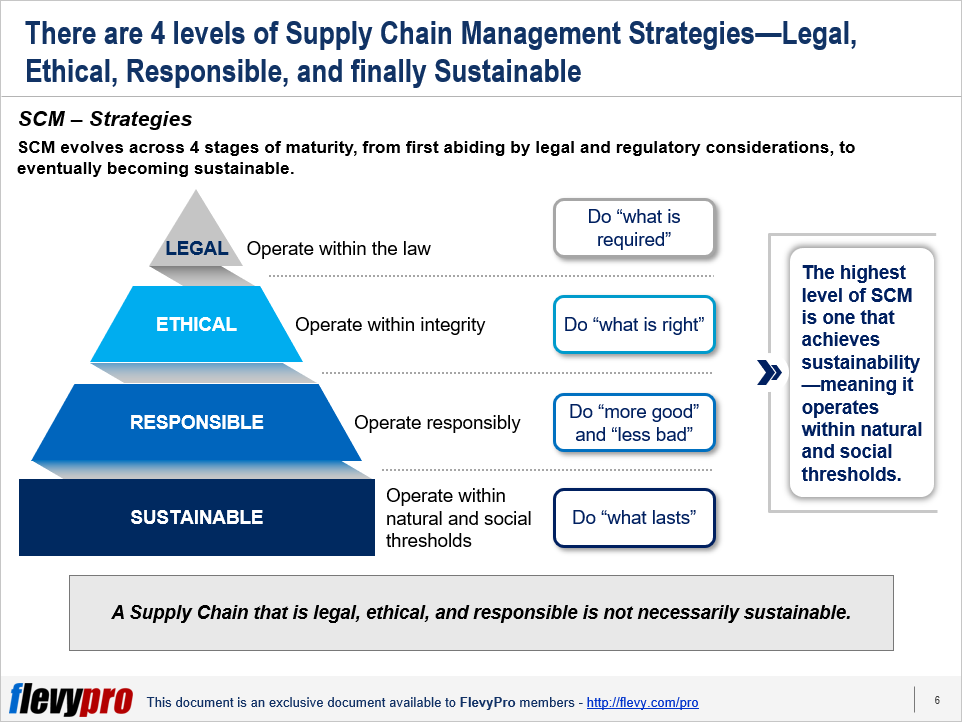
There are 4 Levels of Supply Chain Management Strategies. The first 3 strategies are foundational Supply Chain Strategies.

Before any Supply Chain can be considered sustainable, there are 3 foundational Supply Chain Strategies that need to be undertaken.

  1. Legal Supply Chain Strategy. There are a number of legal rules and regulations that need to be followed by organizations. The Supply Chain Strategy must cater to all legal rules.  An example is a ruling according to the Restrictions of Hazardous Substances Directive (RoHS) wherein an organization must not rely on the mercury, cadmium, and chromium as they result in huge emission of hazardous substances.
  1. Ethical Supply Chain Strategy. To become an ethically strong organization, it is required that the organization operates with integrity and focus on what is right. The organization could develop a policy that governs the organization’s operations. It is also essential that the Supply Chain quality assurance team that is built complies with ethical sustainability.
  1. Responsible Supply Chain Strategy. To become responsible, the organization could spend resources in compliance with sustainable rules. The organization could set up training and development programs to drive sustainability within the organization. It can also focus on environment-friendly activities to boost its social responsibility.

Before an organization can become sustainable, significant efforts must be exerted to put the 3 foundational Supply Chain Strategies in place within the organization.

Reaching the Level of Sustainability

Sustainable Supply Chain Strategy has become increasingly important as more and more organizations are focusing on putting it in place.  According to the MIT Slogan Review, over 75% of organizations listed in the S&P 500 reported sustainability reports where it shows that catering up to the responsibility is becoming highly challenging and important.  There has been a significant increase and inclination towards sustainability and this depicts the importance of becoming sustainable.

With the passage of time, it has become evident that organizations around the globe are becoming fond of sustainable considerations.

Interested in gaining more understanding of Supply Chain Sustainability? You can learn more and download an editable PowerPoint about Supply Chain Sustainability here on the Flevy documents marketplace.

Are you a management consultant?

You can download this and hundreds of other consulting frameworks and consulting training guides from the FlevyPro library.

How To Handle A Downturn and Unlock Opportunities Out of It?

Crisis 2Financial crisis, adverse supply shock, technological disruption, or natural hazards and disasters significantly affect global businesses.  Recessions caused by these global incidents and problems have serious outcomes on commodity prices, stock markets, economies, and even countries.
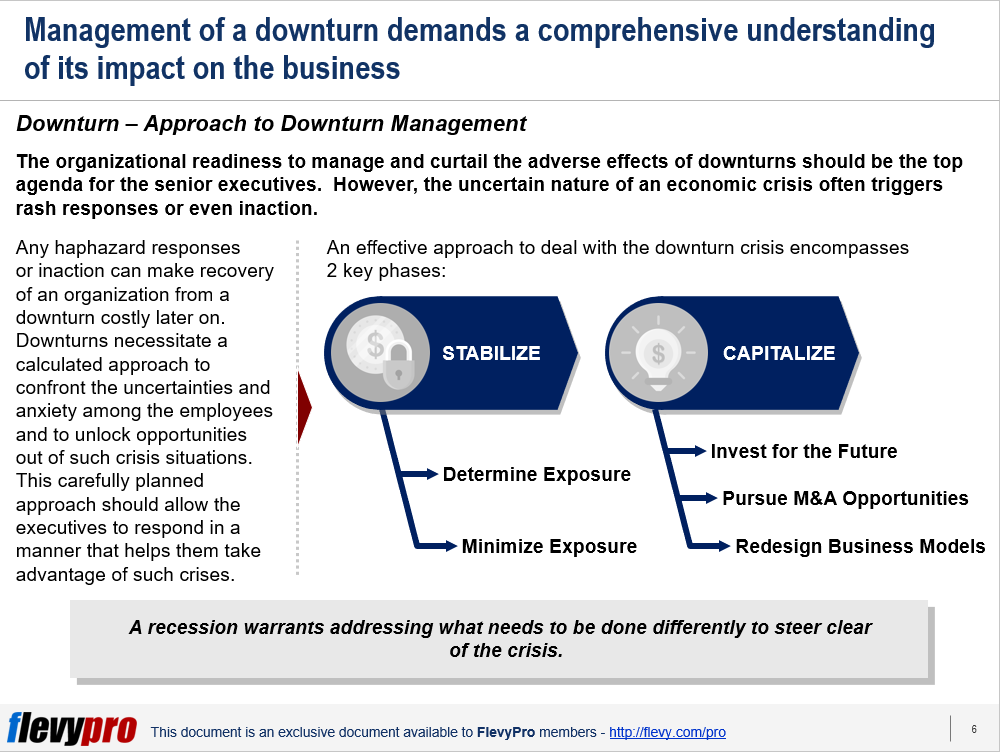
A Downturn can be described as a contracted business cycle with a significant decline in economic activity across markets with subsequent drop in spending, GDP, real income, employment, and manufacturing.  Downturns cause inflation, decline in sales revenues and profits, and cutbacks on R&D and other crucial expenditures.  The scenario challenges businesses because of tightening credit conditions, slower demand, layoffs, and general insecurity.

The organizational readiness to manage and curtail the adverse effects of downturns is the top agenda for the senior executives.  However, the uncertain nature of an economic crisis often triggers rash responses or even inaction.

Any haphazard responses or inaction can make recovery of an organization from a downturn costly later on.  Downturn management necessitate a calculated approach to confront the uncertainties, anxiety among the employees, and to unlock opportunities out of such crisis.  An effective approach to deal with the downturn crisis encompasses 2 key phases:

  1. Stabilize
  • Determine Exposure
  • Minimize Exposure
  1. Capitalize
  • Invest for the Future
  • Pursue M&A Opportunities
  • Redesign Business Models

Let’s dive deeper into the 2 phases.

Stabilize

This phase entails a series of actions to safeguard the organization from downturns and maintain the liquidity required to sustain the period of uncertainty.  Leading organizations take downturns as an opportunity to deploy planned yet urgent, high-priority interventions to maintain standard functioning of the enterprise.  They carry out careful analysis to appraise and curtail the risks of exposure.  Key steps required to stabilize the organization during a downturn include:

  1. Determine Exposure
  2. Minimize Exposure

Determine Exposure

This step demands a methodical assessment of risks associated with exposure.  This necessitates evaluating various scenarios and their impact on the organization as well as on the industry.  The step helps in ascertaining the units that are more susceptible to downturn risks and warrants prompt action.   The analysis of various scenario assists in highlighting and communicating the rationale—for interventions required to manage the downturn—to the people across the organization.

Specifically, the step involves initiating 3 fundamental actions:

  • Conduct Scenario Analysis
  • Quantify Impact
  • Analyze Competition

Minimize Exposure

Once the executives have determined the impact of downturn exposure on their business, it’s time to work on reducing the exposure from crisis risks.  An understanding of the effects of a downturn exposure on the business helps the senior executives discern the most appropriate method to subsist and make the most of their organizational performance during the downturn.

In order to subsist and minimize downturn exposure risks senior leadership needs to maintain enough liquidity and access to capital to make sound investments in future, keeping a check on cash flows by generating weekly / monthly cash reports, cutting down or delaying discretionary spending, carrying out interventions to improve fundamental business, improve business processes, and maintain the organization’s market value and positive outlook for the investors.

Specifically, the executives have to work on achieving these 3 objectives:

  1. Protect Financials
  2. Protect Existing Business
  3. Maximize Valuation.

Capitalize

The Capitalize phase focuses on growing the business and making the most of the economic situation.  Leading organizations prudently manage downturns with greater diligence and immediate, well-thought-out response.  Downturns do not preclude executives from investing in critical interventions.  Most investments take time to fruition and postponing crucial investments may put an organization on the back foot when economic conditions normalize.

To capitalize on these hard times, senior executives need to carefully think about and prioritize the various investment options and endeavors critical for improving productivity and revenue, consolidate the business through mergers or acquisitions, hold back spending on projects with unclear results, shelve the endeavors that do not have a key role in future success, and invest in developing their people.

Specifically, they should chart out 3 key actions to take advantage of the crises and emerge rejuvenated after these tough times:

  1. Invest for the Future
  2. Pursue M&A Opportunities
  3. Redesign Business Models

Interested in learning more about the phases and key actions required to manage Downturns?  You can download an editable PowerPoint on Downturn Management and Transformation here on the Flevy documents marketplace.

Are you a Management Consultant?

You can download this and hundreds of other consulting frameworks and consulting training guides from the FlevyPro library.