Business Process Reengineering (BPR): Are We Succeeding or Failing?

Business Process Reengineering (BPR) is a practice of rethinking and redesigning the way work is done to better support an organization’s mission and reduce costs. In all too many companies, reengineering has been not only a great success but also a great failure. After months, even years, of a careful redesign, these companies achieve dramatic improvements in individual processes only to watch overall results decline.

The promise of reengineering is not empty. It can actually deliver revolutionary process improvements, and major reengineering efforts are being conducted around the world. It can even lead organizations to achieve a successful Business Transformation.

Yet, companies cannot convey these results to the bottom line.

The Strategy that is BPR

Business Process Reengineering (BPR) is a Business Management strategy focused on the analysis and design of workflows and business processes within an organization. Often, companies direct Process Reengineering initiative on 2 key areas of business. One is in the use of modern technology to enhance data dissemination and the decision- making process. The second key area is the alteration of functional organizations to form functional teams.

As a strategy, Business Process Reengineering can greatly impact on the organization. It can help organizations fundamentally rethink how work must be done to improve customer service, cut operational costs, and become world-class competitors. It can help companies radically restructure their organizations by focusing on the ground-up design of their business process. BPR, as a strategy, can direct organizations to achieve Operational Excellence.

In the process, there are 2 dimensions that are critical in translating these short-term narrow-focus process improvements into long-term profits.

Understanding the 2 Dimensions of BPR
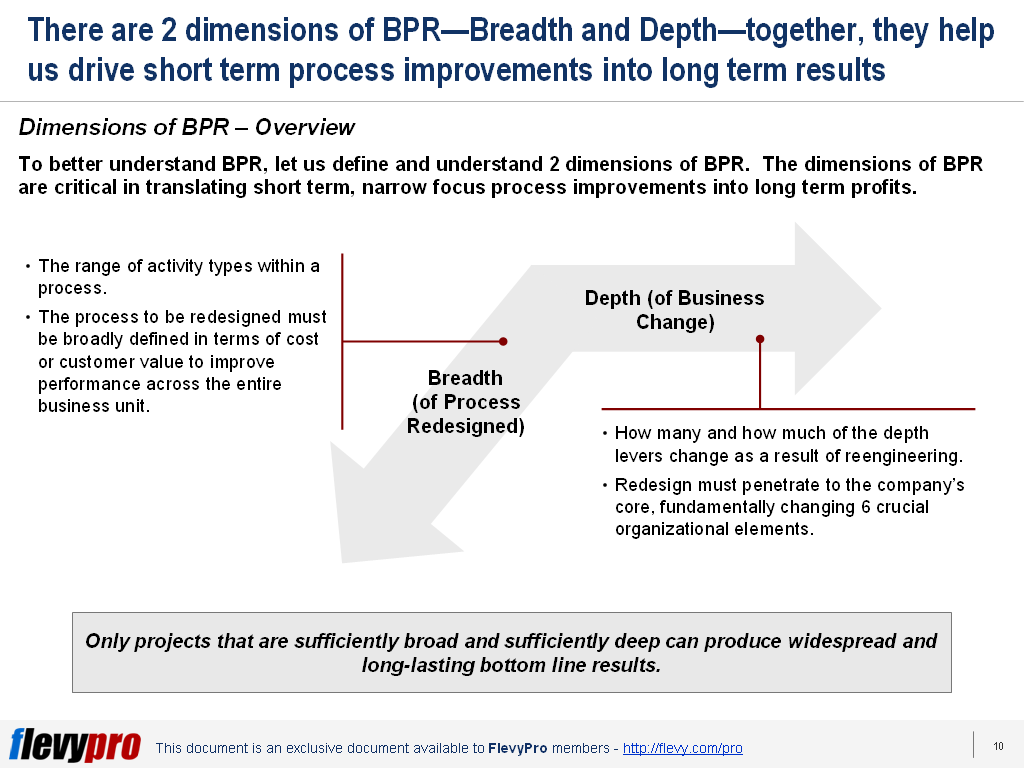
  1. Breadth. Breadth is a dimension of BPR that focuses on the range of activity types within a process. It includes the identification of activities includes in the process being redesigned that are critical for value creation in the overall business unit. Breadth can reduce overall business unit costs and can even reveal unexpected opportunities for a redesign.
  1. Depth. This is the dimension of BPR that focuses on the abstraction levels of process logic within a process. It refers to how many and how much of the depth levers change as a result of reengineering. Depth provides the most dramatic process cost reduction and avoids the classic reengineering pitfall of focusing on fixing the status quo.

Having a good understanding of the 2 Dimensions of BPR will open a range of opportunities for organizations to achieve innovative performance and enhancements.

Interested in gaining more understanding of the Dimension of Business Process Reengineering (BPR)? You can learn more and download an editable PowerPoint about Dimension of Business Process Reengineering here on the Flevy documents marketplace.

Are you a management consultant?

You can download this and hundreds of other consulting frameworks and consulting training guides from the FlevyPro library.

Customer-centric Culture: An Imperative in Today’s Age of the Customer

The use of the Internet and other online tools have turned consumers to be more empowered and are now shopping differently. Customers are customer centric culture 1becoming more demanding and accustomed to getting what they want.

With greater access to reviews and online rating, customers are better equipped to switch to new products and services. Consumers now want to buy products and services when, where, and however they like. They expect companies to interact with them seamlessly, in an easy, integrated fashion with very little friction across channels.

As customer expectation continues to evolve–accelerated by the amplifying forces of interconnectivity and technology–markets are becoming increasingly fragmented with demand for greater product variety, more price points, and numerous purchasing and distribution channels.

Companies should be able to adapt to these increasingly disparate demands quickly and at scale. Staying close to the Customer Experience across an increasingly diverse customer base changing over time is no longer a matter of choice. It is a business imperative and a matter of corporate survival.

The Age of the Customer now calls for companies to be a Customer-centric Organization. Successful ones have discovered that driving customer-centricity depends, first and foremost, on building a Customer-centric Culture.

The Case for Customer-centricity

In the Age of the Customer, business as usual is not enough. Customers expect companies to interact with them seamlessly. Customers want companies to anticipate their needs and technology must have lowered barriers to entry to allow unorthodox competitors to disrupt markets.

The Age of the Customer has made it imperative for companies to have a customer-centric culture. A Customer-centric Culture can empower and control employee behavior. It is a culture that prioritizes the common understanding, sense of purpose, emotional commitment, and resilience. It is a culture where leaders and employees understand the company’s brand promise. Finally, and most importantly, a customer-centric culture is a culture that is committed to delivering exceptional customer experience.

Companies with a Customer-centric Design must integrate, within its core, primary and secondary cultural attributes essential to complete its customer-centric culture framework.

The Corporate Culture Framework: Its Primary and Secondary Cultural Attributes

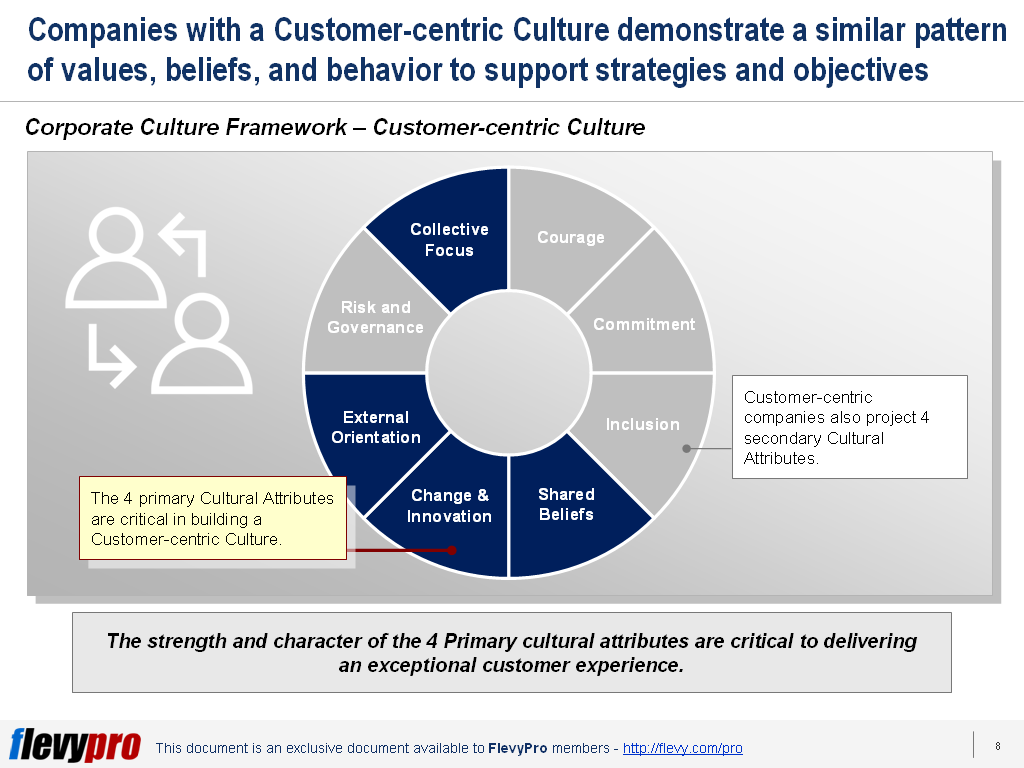
In a customer-centric Corporate Culture framework, the primary cultural attributes are critical in building a customer-centric culture. It also has 4 Secondary Cultural Attributes to complete that transformation.

The 4 Primary Cultural Attributes

  1. Collective Focus
    This is a shared vision articulated on what it means to deliver great customer service. Significant resources are devoted to communicating the customer value and all employees understand their role in delivering value.
  1. External Orientation
    External Orientation is having a full understanding of the company through the customer’s eyes. Outside-in perspectives are taken, seeing themselves as customers see them.
  1. Change and Innovation
    In Organizational Change and Innovation, the corporate value system is in place that values failing fast and learning quickly. The notion that mistakes are learning opportunities is embedded in the organization.
  1. Shared Beliefs
    Shared Beliefs is an attribute where employees share a common ideology and commitment to core values. The company strongly encourage strong service mentality and the desire to help others.

The 4 Secondary Cultural Attributes

  1. Risk and Governance
    In Risk Management and Governance, the company must have a strong collective focus and shared beliefs about the boundaries of acceptable risk and appropriate behavior.
  1. Courage
    A Customer-centric Culture with this secondary attribute has the resilience to bounce back when things don’t go as planned.
  1. Commitment
    Commitment is the third secondary attribute where employees show dedication to the customer-centric ethos.
  1. Inclusion
    Inclusion, the fourth secondary attribute, is one attribute that reinforces values diversity, authenticity, and uniqueness.

Inculcating these attributes has become imperative to achieve a successful transformation towards a Customer-centric Culture. Strategy Development now requires organizations to master the necessary practices to instill these attributes and the essential reinforcement to ensure that it is sustained.

Interested in gaining more understanding of Customer-centric Culture? You can learn more and download an editable PowerPoint about Customer-centric Culture here on the Flevy documents marketplace.

Are you a management consultant?

You can download this and hundreds of other consulting frameworks and consulting training guides from the FlevyPro library.

The 6 Core Capabilities of a Customer-centric Organization: Your Ammunition to Winning a Highly Demanding Customer

Today’s customers are better informed, better connected, and more demanding than ever before. CEOs are now concerned about Customer pic1 6 Core capabilities of customer centric organizationLoyalty and they recognize that mastery of the customer agenda is essential. In fact, global leaders of successful businesses recognize that creating a customer-centric, digitally-transformed business is a top priority.

In this age of digital disruption, how can organizations engage customers, increase Customer Loyalty, and achieve profitable growth? What is most appropriate when it comes to Customer-centric design?

Almost every market is experiencing a fundamental change. Consumer expectations have shifted and digital technologies are making the biggest impact on businesses large and small since the start of the information age. Ultimately, businesses need to navigate the challenges of digital disruption and find new ways to create economic value and drive growth.

The challenge today is what it takes for organizations to be a Customer-centric Organization.

Unraveling the 6 Core Capabilities of a Customer-centric Organization

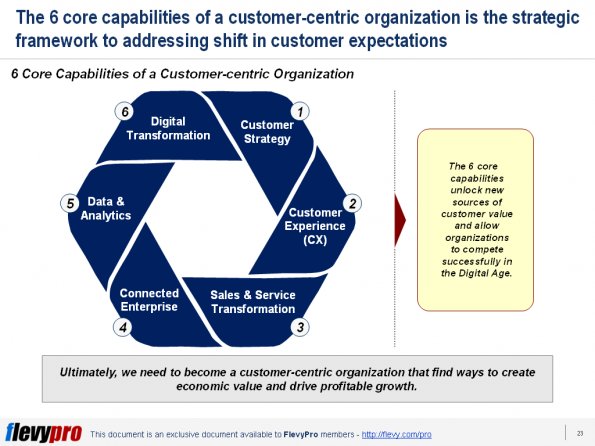
A Customer-centric Organization must have 6 Core Capabilities to compete in the Digital Age. In this global time, customer-centricity ceases to be a differentiator. It has become a matter of survival.

pic2 6 Core Capabilities of Customer-centric Organization

The first 2 Core Capabilities are Customer-directed. These are Customer Strategy and Customer Experience (CX).

  1. Customer Strategy. The first core capability, Customer Strategy is focused on addressing changing customer needs and behavior. It involves the development of a clear view of customer behavior and intentions using data and analytics. Customer Strategy can be applied in several ways. It can be used to refine and develop a proposition or even inform major investments in new media content.
  1. Customer Experience (CX). Customer Experience (CX) is that core capability that generates a significant competitive advantage – a double revenue growth against industry counterparts. It is being able to respond to customer needs balanced with understanding the values customers bring to the enterprise. The world’s most advanced customer businesses often undertake customer journey mapping and experience design which are critical to executing customer-centric change.

The second 2 Core Capabilities focus on front office capability and across the enterprise value chain. These are Sales & Service Transformation and Connected Enterprise.

  1. Sales & Service Transformation. As the third core capability, Sales & Service Transformation is essential to becoming a customer-responsive business. This is a newly digitized and fully integrated front office capability that can attract, engage, acquire, and continually engage with customers. With the modernization and transformation of front office functions, Marketing, Sales, and Service teams get to have better ideas on how to work together more effectively. This leads to a full end-to-end Business Transformation.  A core concept to Service Transformation is the development of Service 4.0 capabilities.
  1. Connected Enterprise. Focused on delivering differentiated Customer Experiences, Connected Enterprise is an architecture of fundamental capabilities that work across the Enterprise Value Chain, from back office operations through customer-facing interactions. The application of Connected Enterprises has led to companies experiencing an increase in annual revenue and a positive return on investment.

The third 2 Core Capabilities are Data & Analytics and Digital Transformation — your company’s response to a highly demanding digital market.

  1. Data & Analytics. The fourth core capability is Data & Analytics. This core capability is focused on creating actionable insights that drive profitable growth. With the use of Data & Analytics, it can uncover patterns of customer behavior, relevant social media influencers, and channel preferences. It is useful in personalizing propositions, channels, marketing communication, and the experiences offered to customers.
  1. Digital Transformation. The sixth core capability, this is the core capability that can power new ways to engage customers, optimize operations, and transform products. Digital Transformation is delivering the right customer and digital technology. With the advent of virtual reality, augmented reality headsets, the Internet of Things, AI, and cognitive computing, it has changed the way customer-centric companies engage customers. Digital Transformation is not an overnight event. This is a series of incremental steps, each delivering a concrete business advantage.

Developing the 6 Core Capabilities is no easy task. It can be pretty challenging. Companies need to have a good handle of its key challenges and the right approaches to mastering the 6 Core Capabilities. When this is achieved, the high road to global competitiveness is achieved.

Interested in gaining more understanding of these 6 core Capabilities of a Customer-centric Organization? You can learn more and download an editable PowerPoint about the 6 Core Capabilities of a Customer-centric Organization here on the Flevy documents marketplace. There is a series of 3 presentations – Part I, Part II, and Part III that discusses all 6 Core Capabilities.

Are you a management consultant?

You can download this and hundreds of other consulting frameworks and consulting training guides from the FlevyPro library.

When Data is Not Enough: The Need to Understand Purpose-driven Analytics

The Data Analytics Revolution is here. It is transforming how companies organize, operate, manage talent, and create value. In fact, advanced pic1 purpose-driven analyticsdata analytics is now a quintessential business matter. It is important for CEOs and top executives to be able to clearly articulate its purpose and translate it into action. Yet, this is not so.

CEOs and top executives are finding it difficult to articulate the clarity of purpose and act on it. It must not just stay in an Analytics department but must be embedded throughout the organization where the insights will be used. Leaders with strong intuition do not just become better equipped to kick the tires on their analytics efforts.  Leadership Development now calls for leaders to be capable of addressing many critical top management challenges. It now requires employing a range of tools, employing the right personnel, applying hard metrics, and asking hard questions.

Data Analytics is a means to an end. It is a discriminating tool for identifying and implementing a value-driving answer. It can unleash insights that could be the very core of your organization’s approach to improving performance. This, however, cannot be achieved if there is no clarity in the purpose of your data.

Data Analytics Revolution: Are We Ready?

The Data Analytics Revolution is transforming how companies organize, operate, manage talents, and create value. But are we ready for this? A number of companies are reaping major rewards from Data Analytics. But this is far from the norm. More CEOs and top executives are avoiding getting dragged into the esoteric weeds.

Data Analytics have complex methodologies and there is a sheer scale of data sets. Machine Learning is becoming increasingly more important. For us to be ready in the onset of Data Analytics Revolutions, we need to be capable of addressing many critical and complimentary top management challenges. We need to be able to ground even the highest analytical aspirations in traditional business principles and deploy a range of tools and people.

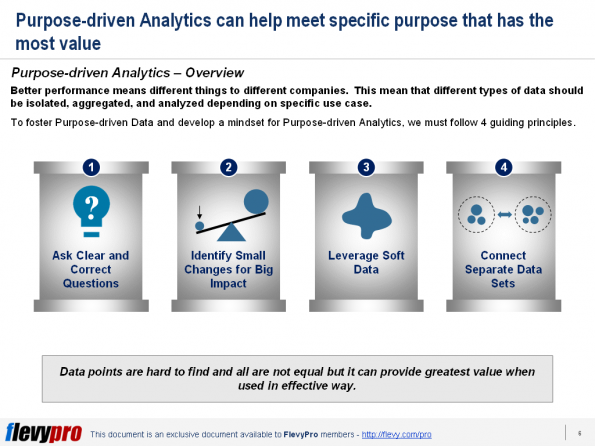
To be properly equipped on the proper use of Data Analytics, we just need to develop a mindset for Purpose-driven Analytics anchored on 4 guiding principles.

The 4 Guiding Principles of Purpose-driven Analytics

pic2 purpose driven analytics

  1. Ask Clear and Correct Questions. The first principle focuses on generating impact the soonest. Hence, precise questions are asked based on the company’s best-informed priorities. Here, clarity is essential.
  1.  Identify Small Changes for Big Impact. The second principle focuses on generating gains even on small improvements. There is a need to identify small points of difference to amplify and exploit because the smallest edge can make the biggest difference.
  1. Leverage Soft Data. The third principle focuses on getting quality insights and generating sharper conclusions. It is at this point wherein the use of softer inputs such as industry forecasts, predictions from product experts, and social media commentary are given more emphasis. Soft data is essential when trying to connect the dots between more exact inputs.
  1. Connect Separate Data Sets. The fourth principle focuses on capturing the untapped value. This principle emphasizes the need to combine sources of information to make sharper insights. When different data sets are examined, the greater is the probability that problems can easily be fixed.

From Learning to Doing: Connecting the Dots

It is not enough that organizations learn about Purpose-driven Analytics. One also needs to be able to put these into effective use. Companies undergoing Digital Transformation must take a multi-faceted approach to analyze data to minimize overwhelming complexity. There are 4 guiding principles for Purpose-driven Analytics implementation. Using these principles will facilitate the effective use of analytics and transform outputs into action.

Interested in gaining more understanding of Purpose-driven Analytics? You can learn more and download an editable PowerPoint about Purpose-driven Analytics here on the Flevy documents marketplace.

Are you a management consultant?

You can download this and hundreds of other consulting frameworks and consulting training guides from the FlevyPro library.

The Age of Digital Transformation Is Unstoppable: Why the Need for Workforce Digitization

In the era of the Fourth Industrial Revolution, we are approaching the age of automation. Together with this is the impending penetration of pic 1 workforce digitizationdigital technology into the labor force which can threaten to destabilize crucial aspects of how employees work by. This can undermine the stability companies depend on to be agile.
With the coming transformation, executives can resolidify their companies by developing a robust Digital Transformation Strategy. There is just a need for executives to adjust their leadership behavior, embrace digital workforce platforms, and deepen their engagement with digitally enabled workers.

Facing the Current Digital Landscape

Workforce Digitization and the powerful economics of automation require a sweeping rethinking of organization structures, influence, and control. According to a recent study made by McKinsey Global Institute, most industries have yet to fully digitize their workforce as these are lagging behind the leading digitized sectors. Digital Transformation is just not happening in most industries. Organizations have to realize that in Workforce Digitization, automation can devastate established assumptions on stability.

The hallmark of an agile age is the ability to be stable and dynamic. The McKinsey research further showed that the workers’ roles and the processes that support them are the bedrock aspects of stability. These are the first and fourth most important factors that differentiate agile companies from the rest.

However, with the onset of automation, the workforce is destabilized. Jobs are disaggregated into component tasks and companies are forced to reassemble remaining tasks into something that makes a new kind of sense. On the other hand, job destabilization can have a dual-faceted impact. Organizations can either become more agile, healthy, and high performing or it can collapse into internal dysfunction.

The direction organizations will go will depend on how it can utilize Digital Workforce Platforms.

The Workforce Platform: Leading Organizations to Stability

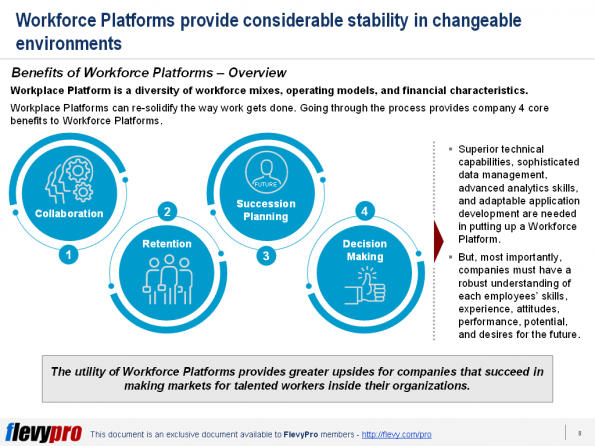
Proper use of Workforce Platforms can help leaders restabilize the workforce and reconceive organizational structures to achieve stability. It has 4 core benefits of achieving stability.

pic 2 Workforce Digitization

  1. Collaboration. Workforce Platforms can be effective staffing coordinators with a multiplex of roles. It can maximize the visibility and mobility of the best people within the organization.
  1. Retention. It can bring science to talent management through the scientific process of retention. Workforce Platforms can help employees grow and develop as their career progresses.
  1. Succession Planning. Workforce Platforms are effective in increasing employees’ engagement in their work through Succession Planning. Through Success Planning, organizations are ensured that strategic capabilities, institutional knowledge, and leadership skills are retained within the organization.
  1. Decision Making. A vital core benefit, it can create conditions where employees feel valued by their organization and are happy in their environment. This is crucial as it can create conditions where employees feel energized and empowered.

Workforce Platforms are effective in leading organizations towards achieving agility. It moves companies to go beyond a one-size-fits-all approach to human resource and talent management.

Maximizing the Benefits of Workforce Platforms.

Benefits gained from Workforce Platforms can further be maximized. This can be achieved when there are appropriate support processes in place. There should be dynamic scheduling and appropriate leadership decisions. Our leaders are our organization’s architect. Being able to make the right leadership decisions can lead organizations to successfully maneuver their transformation in this age of automation. At this stage, Leadership Development plays a vital role.

Interested in gaining more understanding of Digital Transformation and Workforce Digitization? You can learn more and download an editable PowerPoint about Digital Transformation: Workforce Digitization here on the Flevy documents marketplace.

Are you a management consultant?

You can download this and hundreds of other consulting frameworks and consulting training guides from the FlevyPro library.

Just Too Many Processes? Gain Back your Competitiveness through Global Process Optimization

Management processes–everything from how a company manages risk to how it gets supplies Global Process Optimization Pic2for factories to how it manages and develops people–are some of the primary ways that global companies impose order and consistency on a diverse set of global operations.  Companies believe that processes can help share knowledge across divisions and regions to achieve operational excellence. Likewise, seamless delivery and service processes can be central to meeting customer expectations.

In a world where the pace of competition is increasing faster than ever, best-in-class processes can create competitive advantages when it comes to innovation and risk management. However, researches have shown that companies are particularly poor at managing processes. Often there are just too many processes. Worst, executives often do not know where to begin; a Leadership Development dilemma.

Global Process Optimization is the strategic approach to building a real Competitive Advantage.  However, it can be a challenge and there are pitfalls that organizations must face.

The Pitfalls of Organizations

Global organizations are particularly poor at managing processes. Processes are considered one of the 3 weakest aspects of organizations and strengthening them is crucial.

Based on a McKinsey survey of executives, executives do not know what their processes are.  Inasmuch as there are just too many processes, these processes do not reflect new customer needs. In fact, there exists a resistance to change that can be damaging to an organization.

Organizations have to understand that processes can go wrong on a global scale and it can bring in a lot of challenges to an organization.

The 3 Core Challenges to Global Organizations

Organizations are faced with 3 core challenges when dealing with processes and transforming them to a global scale.

Global Process Optimization pic1

  1. A Plethora of Processes. When there are a plethora of processes, there are just too many processes and too little value.  This happens when executives are unable to differentiate between processes that are essential to creating global value and those that are inessential but offer benefits if these are consistent.  Executives also fail to differentiate between processes that are crucial to customers or those that create value and those that do not. A plethora of processes is also created when the operation is in various locations or as a result of M&A activity.
  1. Overstandardization. How do you know that overstandardization exists? It is when processes are so rigid that they are slow to respond to new growth. As a result, there is a dramatic decrease in local responsiveness. This core challenge often arises because there is just too much concern about maximizing control and reducing risk.
  1. Resistance to Change. This is the third core challenge faced when change is introduced and there is resistance. Resistance to change often occurs when there is difficulty in changing customer-facing processes until the organization is faced with customer backlash. Executives often fail to understand customers’ preference for standard global service. The thinking is often directed towards country-specific variations which are not often what customers like.

Overcoming the 3 core challenges can be done. Organizations just need to take on a 3-phase approach that will ensure that all global processes are enabling performance. These are Prioritize, Optimize, and Implement. A 3-phase approach is an effective tool towards approaching Global Process Optimization in a strategic manner where value is maximized at minimal cost and complexity.

Interested in gaining more understanding of Global Process Optimization? You can learn more and download an editable PowerPoint about Global Process Optimization here on the Flevy documents marketplace.

Are you a management consultant?

You can download this and hundreds of other consulting frameworks and consulting training guides from the FlevyPro library.

In this Digital Age, Are You Ready for Digital Reinvention?

“All you need is your own imaginationDigital Reinvention pic2
So use it that’s what it’s for (that’s what it’s for)
Go inside, for your finest inspiration
Your dreams will open the door (open up the door)” Madonna

Madonna is a perfect example of reinvention. A very versatile actress, Madonna has the ability to adapt to new trends; someone that can send a lesson to companies struggling with their own digital revolution.

In this digital age, change is rewarded while being static is being punished. Companies must be open to Digital Transformation; a radical reinvention to find new, significant, and sustainable sources of revenue.  Incremental adjustments or building something new outside of the core business can provide real benefits and, in many cases, are a crucial first step for a digital transformation. But if these initiatives do not lead to more profound changes to the core business and avoid the real work of re-architecting how the business makes money, the benefits can be fleeting and too insignificant to avert a steady march to oblivion.

Discovering Digital Reinvention

Reinvention is a rethinking of the business itself.  Based on a Digital Quotient Research, reinvention requires significant commitment. First, the investment must be aligned closely with strategy at a sufficient scale. And second, digital leaders must have a high threshold for risk and must be willing to make bold decisions.

Digital Reinvention is not a throw-it-all-out approach. If you look at Apple when it moved from a computer manufacturer to music and lifestyle brand, it has reinvented itself while continuing to build computers.  Likewise, this is the case with John Deere.  John Deere is the brand name of Deere & Company that manufactures agricultural, construction, forestry machinery, and others. It continued to sell tractors and farm equipment while reinventing itself into a creator of online services for farmers.

Digital Reinvention is an innovative approach to laying the foundation for future growth while continually pushing improvement targets. Digital Reinvention is Business Transformation in action.

Approaching Digital Reinvention

Digital Reinvention will put new demands on leadership. Hence, an organization must have a strategic approach to Digital Reinvention: The 4Ds of Digital Reinvention.

Digital Reinvention pic1

  1. Discover. The primary goal of Discover is to develop a tight business case for change based on facts. Organizations must discover what your digital vision is based on where the value is. This will shape your digital ambition, strategy, and business case.
  1. Design. Designing, creating, and prototyping breakthrough experiences is the main focus of Design. It is reinventing and developing new capabilities and breakthrough Customer Journeys.
  1. Deliver. This is the third phase where organizations need to gather speed and scale necessary for reinvention. Its primary focus is to deliver and develop a network of partners who can rapidly scale your ambition. There is a need to activate an ecosystem to rapidly deliver at scale.
  1. De-risk. The 4th D, it is focused on structuring the change program, resources, and commercial model to reduce operational and financial risk. It is essential for senior leaders to focus on structural and organizational issues that can hamper the organization’s ability to manage cyber risk.

Having a good handle of the 4Ds of Digital Reinvention will prepare leaders towards Digital Transformation and new challenges.  It will be able to come up with the right answers to key questions that will arise in preparation for Digital Reinvention. Coming up with the proper answers to these crucial questions can guide companies to reinvent themselves ad stay in the game.

Interested in gaining more understanding of Digital Reinvention? You can learn more and download an editable PowerPoint about Digital Reinvention here on the Flevy documents marketplace.

Are you a management consultant?

You can download this and hundreds of other consulting frameworks and consulting training guides from the FlevyPro library.

Finding Corporate Philanthropy a Challenge? Let This Primer Guide You

“To give away money is an easy matter and in any man’s power. But to decide to whom to give it and how large and when, and for Corporate Philanthropy Primer pic 2what purpose and how, is neither in every man’s power nor an easy matter.” Aristotle

Corporations can be a source of grant funding. Corporations and local businesses donate grants because they care about some particular issue or issues to the point of wanting to get involved. They have the financial capacity and they want to contribute to the community or society and see positive outcomes.  Oftentimes, these efforts will be aligned with their Corporate Social Responsibility programs.

Corporate grant programs sponsored by large, multinational corporations may look identical to the grant programs run by foundations. This includes a formal application process and well-defined programmatic areas. Other companies choose to limit their giving to a handful of local nonprofits with support consisting of one-time cash gifts or in-kind donations of goods or services.

Organizing Corporate Giving Programs require Strategy Development. Companies have to properly define their objectives and the reasons why it plans to come up with giving programs. Setting up a Grant Funding Program requires having sufficient understanding, knowledge, and systems in place to make it run successfully.

Corporate Philanthropy: Taking the Right Journey

Corporate Philanthropy is the act of corporation in promoting the welfare of communities through charitable donations of funds or time. Corporations must be clear on what type of support it will offer and the ways of promoting these programs. When this is done, it is most effective for the company to establish its Corporate Giving Program and set the right direction for its Corporate Philanthropic Journey.

Corporate Philanthropy Primer pic1Having a good understanding of the types of Corporate Philanthropy can better guide corporations to take a good start in its Corporate Philanthropic Journey. Corporations can have a choice of whether they provide cash gifts, non-cash or donations of goods and services.

Either way, corporations initiate giving programs to achieve specific objectives and reasons. Corporations differ from foundations. Foundations make grants to further a mission that has a social good at its heart. On the other, corporate donors make gifts to complement or advance business interests.

Jumpstarting the Corporate Philanthropic Journey

Every corporation dedicated to undertaking its Corporate Philanthropic Journey wants to give it a good start. Hence, it is important for corporations to engage in various ways to promote its Corporate Giving Programs. Creating awareness is essentially important as it creates interest from target beneficiaries and moves them to action.

Corporate Giving Programs can also be promoted through partnerships and collaborations. It is a tactical way of directly informing target proponents of the company’s Corporate Giving Program.

Creating awareness of the Company’s Corporate Giving Programs can be achieved using six strategic approaches.

Interested in gaining more understanding of Corporate Philanthropy? You can learn more and download an editable PowerPoint about Corporate Philanthropy Primer here on the Flevy documents marketplace.

Are you a management consultant?

You can download this and hundreds of other consulting frameworks and consulting training guides from the FlevyPro library.

How to Use the Porter’s Value Chain in Identifying Cost Savings and Differentiation Opportunities?

Value Chain1The Value Chain concept, first described by Dr. Michael Porter in 1985, is a series of actions that a firm—in a specific industry—accomplishes to produce a valuable product or service for the market.  The value chain notion visualizes the process view of an organization, perceiving a manufacturing or service organization as a system comprised of subsystems of inputs, transformation processes, and outputs.

Another way to define the Value Chain principle is, “transforming business inputs into outputs, thereby creating a value much better than the original cost of producing those outputs.”  These inputs, processes, and outputs entail acquiring and utilizing resources—finances, workforce, materials, equipment, buildings, and land.

An industry Value Chain includes the suppliers that provide the inputs, creation of products by a firm, distribution value chains, till the products reach the customers.  The way Value Chain activities are planned and executed determines the costs and profits.

Value chains consist of set of activities that products must undergo to add value to them.  These activities can be classified into 2 groups:

  • Primary Activities
  • Secondary Activities

Primary activities in Porter’s Value Chain are associated with the production, sale, upkeep, and support of a product or service offering, including:

  • Inbound Logistics
  • Operations
  • Outbound Logistics
  • Marketing and Sales
  • Service

 The secondary activities and processes in Porter’s Value Chain support the primary activities.  For instance:

  • Procurement
  • Human resource management
  • Technological development
  • Infrastructure

Value Chain Analysis Benefits

The analysis of a Value Chain offers a number of benefits, including:

  • Identification of bottlenecks and making rapid improvements
  • Opportunities to fine-tune based on transforming marketplace and competition
  • Bringing out the real needs of an organization
  • Cost reduction
  • Competitive differentiation
  • Increased profitability and business success
  • Increased efficiency
  • Decreased waste
  • Delivery of high-quality products at lower costs
  • Retailers can monitor each action throughout the entire process from product creation to storage and distribution to customers.

Value Chain Analysis (VCA) Approach

Businesses seeking competitive advantage often turn to Value Chain models to identify opportunities for cost savings and differentiation in the production cycle.  The Value Chain Analysis (VCA) process encompasses the following 3 steps:

  • Activity Analysis
  • Value Analysis
  • Evaluation and Planning

Activity Analysis

The first step in Value Chain Analysis necessitates identification of activities that are essential to undertake in order to deliver product or service offerings.  Key activities in this stage include:

  • Listing the critical processes necessary to serve the customers—e.g., marketing, sales, order taking, distribution, and support—visually on a flowchart for better understanding.
    • This should be done by involving the entire team to gather a rich response and to have their support on the decisions made afterwards.
  • Listing the other important non-client facing processes—e.g., hiring individuals with skills critical for the organization, motivating and developing them, or choosing and utilizing technology to gain competitive advantage.
  • This stage also entails gathering customers’ input on the organization’s product or service offerings and ways to continuously improve.

Value Analysis

The second phase of the Value Chain Analysis necessitates identifying tasks required under each primary activity that create maximum value.  This phase is characterized by:

  • Ascertaining the key actions for each specific activity identified during the first phase.
  • Thinking through the “value factors”— elements admired by the customers about the way each activity is executed.
    • For example, for the order taking process, customers value quick response to their call, courteous behavior, correct order entry, prompt response to queries, and quick resolution of their issues.
  • Citing the value factors next to each activity on the flowchart.
  • Jotting down the key actions to be done or changes to be made to under each Value Factor.

Interested in learning more about the other phases of the Value Chain Analysis Approach?  You can download an editable PowerPoint on Strategy Classics: Porter’s Value Chain here on the Flevy documents marketplace.

Are you a Management Consultant?

You can download this and hundreds of other consulting frameworks and consulting training guides from the FlevyPro library.

Are You Interested In Transforming Your Traditional Warehouse into a Lean Warehouse?

Warehouse 3As the last decisive step in customer service, a warehouse ensures cost effective distribution.  Latest technological innovation has turned warehousing into a competitive advantage.  It offers untapped potential for improvement. However, warehousing is a hugely neglected part of global supply chains.  There is inconsistency in picking, packing and shipping orders, storing receipts, and managing inventory and logistics operations.
These and the following roadblocks in the way of smooth warehousing operations and Lean Management exist in every traditional warehouse:

  • Lack of focus on acquiring technology to facilitate in improving efficiency and quality.
  • Inability to utilize a structured approach to ascertain the reasons for poor performance.
  • Lack of a big picture viewpoint pertaining to processes, costs, or external supply chain partnerships.
  • Absence of a continuous improvement culture to achieve warehouse operations excellence.
  • Lack of communication, organization, and proper training of resources.

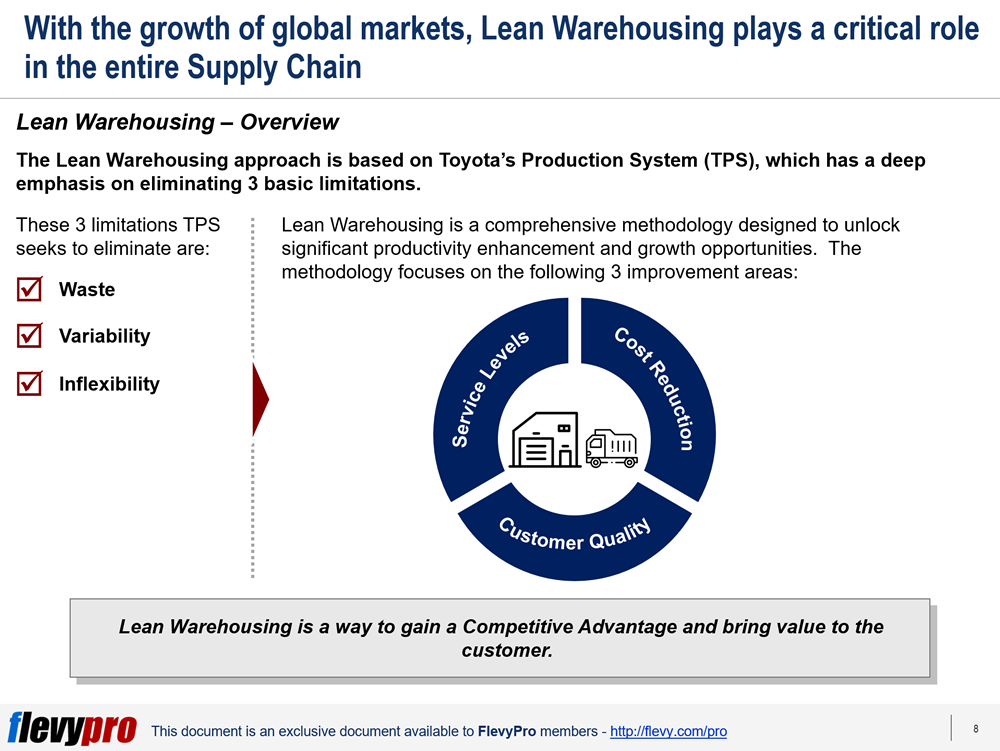
These shortcomings call for implementing Lean Warehousing methodology to unlock improvement opportunities and savings in operational, efficiency, and maintenance related costs.  First initiated by Toyota, the Lean Warehousing approach has a deep emphasis on eliminating 3 basic limitations: waste, variability, and inflexibility. The Lean Warehousing methodology focuses on the following 3 improvement areas:

  1. Cost Reduction
  2. Customer Quality
  3. Service Levels

Cost Reduction

The Lean Warehousing methodology concentrates on increasing productivity and reducing operating costs.  This is achieved by:

  • Cutting undue walking and searching
  • Preventing needless replenishment, reworks, waiting times, and double handling
  • Upgrading demand and capacity planning and manpower allocation

Customer Quality

A Lean Warehouse seeks to take the customer quality to the next level by avoiding:

  • Order deviations
  • Picking errors
  • Damaged goods

Service Levels

Improving service levels is at the center of a Lean Warehousing methodology, which involves:

  • Reducing lead times
  • Enhancing on-shelf availability

Lean Warehousing Transformation

Lean Warehousing Transformation entails streamlining operations to identify waste, know how to increase service levels, implement standardization and innovative ideas, and learn to evaluate and manage performance.  Such transformation becomes a reality in an experiential learning environment and by developing organizational capabilities in 3 critical areas:

  1. Operating System
  2. Management Infrastructure
  3. Mindset and Behaviors

Operating System

The organizational capability to configure and optimize all company physical assets and resources to create value and minimize losses.  The focus areas under operating systems include eradicating variability, encouraging flexibility, and promoting end-to-end design.

Management Infrastructure                                                                   

The organizational capability to strengthen formal structures, processes, and systems necessary to manage the operating system to achieve business goals.  The focus areas under Management Infrastructure are performance management, organizational design, capability building, and functional support process.

Mindset and Behaviors

The organizational capability to manage the way people think, feel, and act in the workplace individually as well as collectively.  The target areas to focus on here include a compelling purpose, collaborative execution, up-to-date skills, drive to improve, and committed leadership.

Model Warehouse Implementation

Lean Warehousing Transformation necessitates developing a “Model Warehouse,” which presents facilities for supply chain people to practically experience state-of-the-art warehouse operations in a modern warehouse and shop-floor environment.  The Model Warehouse incorporates newest technology and systems, and offers real-life conditions for building capabilities—i.e., optimization of storage, pick and pack, and dispatch processes.  Newest technologies—e.g., Smart Glasses and HoloLenses—available at the facility help improve the performance of pickers significantly and execute multi-order picking efficiently.

Such a setting allows people to observe and analyze the performance of an exemplary warehouse and implement this knowledge at their own premises.  Leading organizations organize a week-long rigorous knowledge sharing workshop—in an experiential learning environment of a Model Warehouse—for their people to have a hands-on experience to learn Lean Warehousing, actual picking, packing, root cause analysis, and performance management.  The participants of the Model Warehouse Knowledge Sharing Workshop are excellent candidates for “change agents” to implement Lean Transformation.

Interested in learning more about Lean Warehousing, Model Warehouse Implementation, and Lean Warehousing Transformation?  You can download an editable PowerPoint on Lean Warehousing Transformation here on the Flevy documents marketplace.

Are you a Management Consultant?

You can download this and hundreds of other consulting frameworks and consulting training guides from the FlevyPro library.